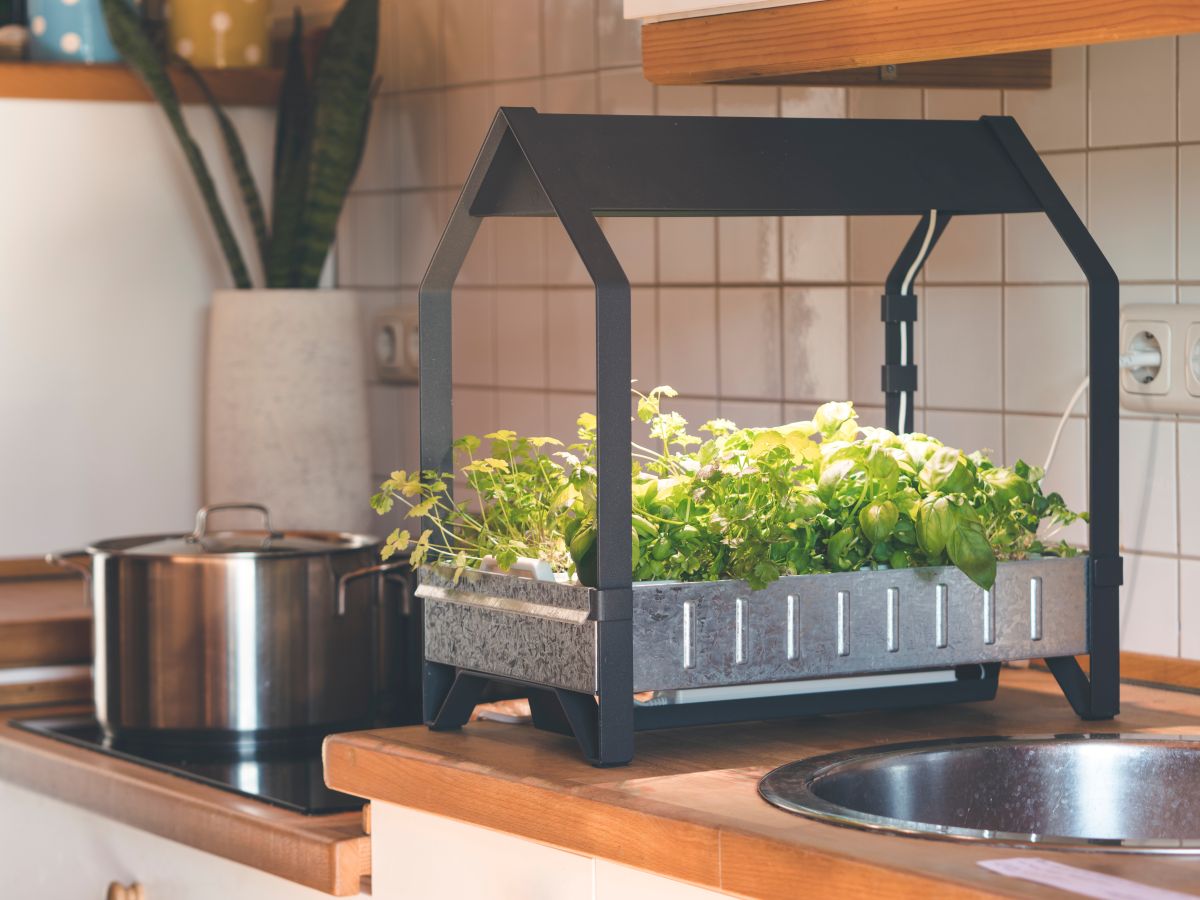
UTIA horticulture experts provide help for small-space food growing indoors
KNOXVILLE, Tenn. – The short days of winter might not look like a good time for gardening, but University of Tennessee Institute of Agriculture horticulture experts can help you beat the cold temperatures and fewer hours of sun by gardening indoors with the right plant and light source.
In a series of UT Extension publications about small-space food production, horticulture specialists explain how home gardeners can make the most of the space they have.
“One of the simplest ways to begin indoor gardening would be containers for herbs or leafy green crops,” said Natalie Bumgarner, residential and consumer horticulture specialist with UT Extension and professor of plant sciences. “Ensuring plants have adequate light is the first task. Most indoor crops will need supplemental lighting, especially in the winter.”
UT Extension publication W1288B Small-Space Indoor Food Production provides tips for growing food crops indoors at any time of year. It is authored by Bumgarner and UT Extension agricultural and natural resources agents Amy Dunlap from Davidson County and Haley Treadway from Hamilton County.
Site and Lighting
Herbs and leafy vegetable crops require at least 4 to 6 hours of direct sunlight per day. Ideal light levels will be higher than light needs for most houseplants, and light needs for fruiting crops are even higher. You may be able to consider areas in your space with some natural light such as sunrooms, windowsills or areas near a large window; however, Bumgarner suggests that gardening with only supplemental light may be easier and provide more consistent lighting than trying to adjust supplemental lighting through the season to augment changing natural light levels. Use fluorescent and light emitting diodes (LED) fixtures because they are smaller, lighter and easier to add to an indoor growing site.
Be sure that the location does not receive direct air flow from a heat/air conditioning vent. Plastic shields on vents can be used if needed to redirect air flow.
Containers and Hydroponic Systems
Small to medium containers placed on a windowsill, table or other flat surface could be used to grow a range of herbs and leafy vegetables. Supplemental or sole source lighting can be installed over the containers. Watering should be done when the upper portion of the growing mix is dry but not the entire container. Apply controlled-release fertilizers or soluble fertilizers once or twice a month to provide the needed nutrients. Be sure to follow the directions provided with the product and select fruiting/bloom formulas or leafy/grow formulas depending on the crop.
Commercially designed and manufactured hydroponic systems range from modern and fun tabletop systems with integrated lighting to scaled-down versions of systems used in hydroponic greenhouses where plant roots sit in or are bathed in hydroponic nutrient solution. Also, you can create your own growing systems from simple mason jars or plastic containers.
Watering and fertilizing occur together for indoor hydroponic growing systems. Often at this small scale, purchasing a pre-mixed liquid or easily soluble fertilizer will be the simplest method. Use fertilizers designed for hydroponic growing because the ratios of nutrients will differ from those used in soil or growing mixes.
What to Plant
Microgreens or baby greens are some of the quickest crops to grow with the lowest light requirements. With some experience in leafy greens, new crops or more complex systems could be added to the indoor growing area. UT Extension Publication W1288C Crops and Cultivars for Small-Space Food Production contains lists of warm season, cool season and herb cultivars recommended for containers.
More Online Resources
UT Extension Publication W346J: The Tennessee Vegetable Garden: Small-Scale Microgreen Production
UT Extension Publication W844A An Introduction to Small-Scale Soilless and Hydroponic Vegetable Production
Video: Beginner Tips for Small-Space Food Production with Natalie Bumgarner
Video: Crops and Cultivars for Small-Space Food Production with Natalie Bumgarner
Video: Introduction to Small-Space Food Production with Amy Dunlap (for more information about hydroponics)
Video: An Overview of Containers and Media for Small Spaces with Natalie Bumgarner
The University of Tennessee Institute of Agriculture is comprised of the Herbert College of Agriculture, UT College of Veterinary Medicine, UT AgResearch and UT Extension. Through its land-grant mission of teaching, research and outreach, the Institute touches lives and provides Real. Life. Solutions. to Tennesseans and beyond. utia.tennessee.edu.