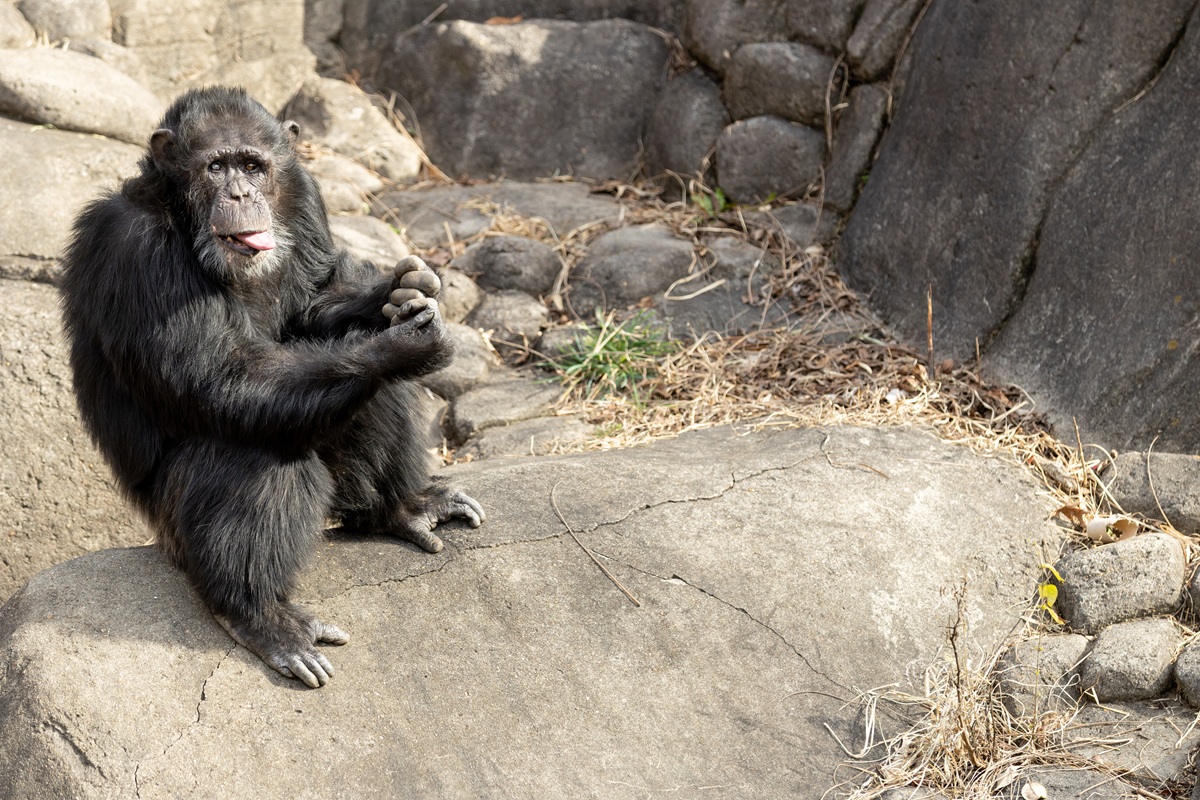
Veterinary and human neurologists work together to remove chimp’s spinal tumor
KNOXVILLE, Tenn. – Lu seemed subdued, quiet, not like his normally outgoing self. People around him grew concerned. He began dragging one foot and then the other, developing sores on both. Then came the doctors.
An MRI revealed Lu, a 35-year-old chimpanzee at Zoo Knoxville, had a tumor on his spinal cord. Specialists at the UT College of Veterinary Medicine (UTCVM) first thought radiation would be the best course of action. But Dr. Talisha Moore, a clinical assistant professor and veterinary neurosurgeon, had another thought.
She texted Dr. James Killeffer, the chief neurosurgeon at UT Medical Center and associate professor in the UT Health Science Center College of Medicine-Knoxville, across the river. They already had a working relationship by hosting each other’s residents, consulting and talking about different neurosurgical approaches for animals and humans, speaking at conferences and planning future collaboration.
This partnership between University of Tennessee animal and human doctors proved to be the perfect medicine for Lu. It also, perhaps, will make its own page in history.
Killeffer looked at the tumor’s images, spoke with the assembled specialists and recommended surgery to remove it. After all, he would do that for a human patient. They set a surgery date in September 2025.
“One of the reasons we got Dr. Killeffer involved was because our thought process was chimps are more like humans than dogs and cats, which we work on all the time,” Moore said.
Moore and Killeffer think this is the first such operation. They are preparing a journal article to publish and officially document the procedure. “This is not a routine surgery and, actually, the first documented surgery either Dr. Killeffer or myself could find for a spinal tumor removal in a chimpanzee,” Moore said.
The team removed the entire tumor, which was an extra osseous hemangioma. Extra osseous means it was outside the bone, and hemangiomas are benign collections of tiny blood vessels, commonly found in people but rarely located in the spine. “It turns out it was a tumor type we are not very familiar with on the vet med side,” Moore said.
Today, Lu is back to normal. “He’s recovered well. He’s climbing. He’s back to his playful self,” said zookeeper Crystal Mugan.
While Killeffer enjoys telling his colleagues about being the only one of them to operate on a chimpanzee, he and Moore plan more collaborations. They plan to work more together on hydrocephalus, a buildup of water on the brain, and the treatment of gliomas, malignant brain tumors found in humans and dogs.
“I think there is a lot to be gained and learned on both sides of the aisle,” Moore said. “This story highlights the collaboration between human medicine and veterinary medicine. If we can become more collaborative as a whole, we can accomplish great things.”
Read more about the surgery and the partnership between UTCVM and UT Medical Center in Our Tennessee, the University of Tennessee System magazine.
Watch a video about Lu’s recovery.
The University of Tennessee Institute of Agriculture is comprised of the Herbert College of Agriculture, UT College of Veterinary Medicine, UT AgResearch and UT Extension. Through its land-grant mission of teaching, research and outreach, the Institute touches lives and provides Real. Life. Solutions. to Tennesseans and beyond. utia.tennessee.edu.