USDA grant creates two new professional development programs for teachers
KNOXVILLE, Tenn. – Virtual reality is entering the agricultural science classroom, and University of Tennessee Institute of Agriculture researchers are helping teachers incorporate and create their own virtual reality resources.
With a $500,000 grant from USDA’s National Institute of Food and Agriculture, a faculty team in the Department of Agricultural Leadership, Education and Communications is building on their findings from a previously funded USDA grant project aimed to further develop efforts to train secondary school teachers and bring virtual reality (VR) to the classroom through the Agriscience Metaverse Academy.
The faculty team is led by Taylor Ruth in collaboration with Tyler Granberry, both assistant professors in the Department of Agricultural, Leadership, Education and Communications, and Nathan Conner, professor in the Department of Agricultural Leadership, Education and Communication at the University of Nebraska-Lincoln.
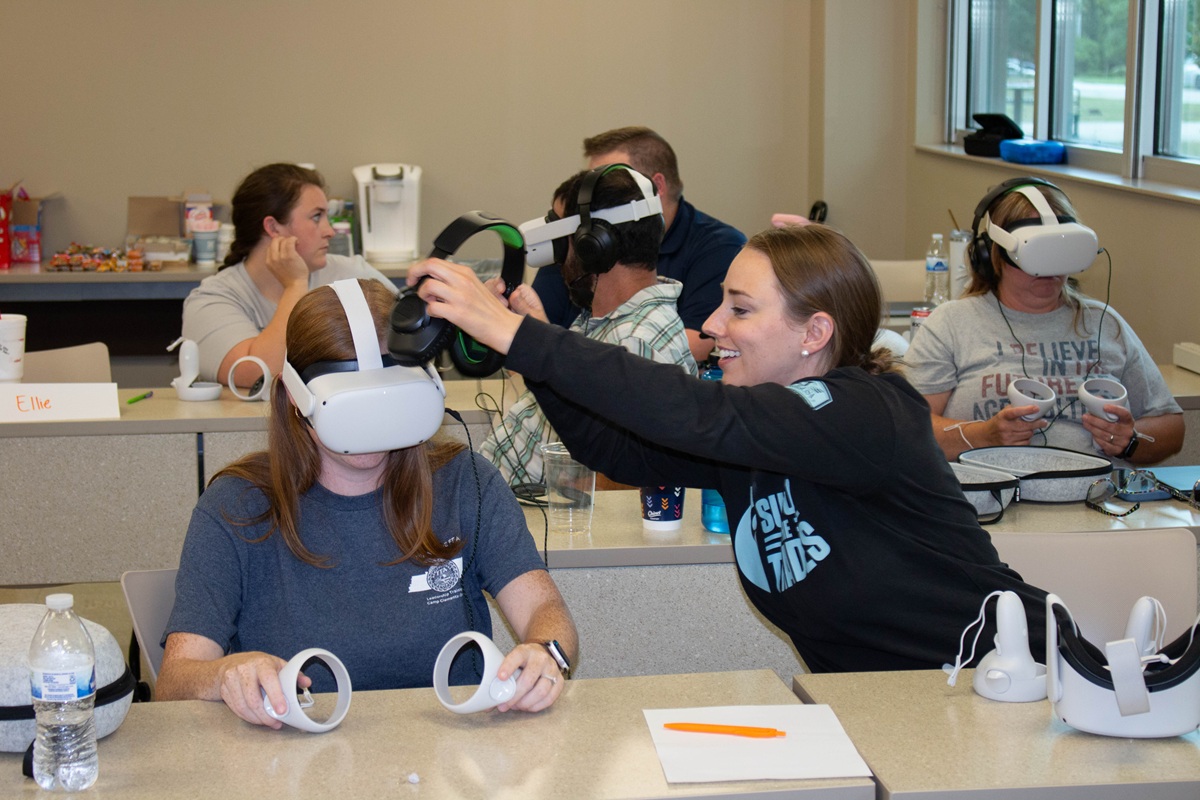
In 2024, 28 agriscience educators in Tennessee and Nebraska attended the original Agriscience Metaverse Academy (AMA), a five-day in-person workshop where they learned how to integrate VR technology into their classes and create curriculum that utilizes the metaverse, a fully interactive online environment. Each teacher received a class set of 12 Meta Quest 2 VR headsets and a 360-degree camera to be used as they implement their new curriculum. Throughout the following school year, the researchers analyzed the benefits of VR learning to determine whether the technology is improving agricultural literacy and increasing student interest in these careers.
The 2024 AMA project, led by Granberry, effectively improved teachers’ confidence when integrating VR into their agriscience curriculum and removed barriers related to accessing equipment, developing VR-enhanced lessons, and implementing classroom management strategies while students used the VR headsets. After integrating VR-enhanced lessons into their classes during the 2024-2025 school year, the first AMA cohort reported their students were excited to learn more about the associated topics, and the technology offered them a novel way to engage students in experiential learning, Ruth said. However, she said a lack of relevant VR content and VR-enhanced lessons related to agricultural and natural resources remained a major barrier to VR’s potential to improving agricultural literacy in secondary education.
“We realized the impact of VR in agricultural education would remain limited without the development of more VR content relevant to agricultural and natural resources, so our team decided to create a new program to empower teachers to create this content themselves,” Ruth said.
This new grant will create two new year-long professional development programs – Advanced AMA: Content Creators and AMA: Cohort II that will engage a total of 30 agriscience teachers from Tennessee and Nebraska.
The Advanced AMA will focus on the development of VR content, with a focus on creating virtual field trips, and will take a group of 10 teachers from Tennessee and Nebraska to the state of Maine in July 2026 for one week to capture and develop virtual experiences.
“We wanted to identify a location for these virtual field trips that would truly be a new and unique experience for both the teachers and the students. The beauty of VR is it can transport us anywhere, so we talked through different options, and it was clear that Maine would be the perfect location for this type of content creation,” said Ruth.
Prior to the week-long trip to Maine, participating teachers, who have all completed prior VR training such as the original AMA, will participate in a four-week-long online program to learn how to capture and edit 360-degree videos for immersive virtual field trips and develop VR-enhanced lessons using problem-based learning. These lessons will be shared with AMA: Cohort II during the summer of 2027, and advanced participants will attend the AMA: Cohort II, a five-day, in-person workshop, to serve as peer mentors.
AMA: Cohort II will be offered in both Nebraska and Tennessee to a total of 20 high school agriscience teachers. Cohort II will receive access to 10 VR-enhanced lessons created for this program along with a class set of 12 Meta Quest 3 VR headsets. They will also learn to create their own lessons from existing VR content using problem-based learning. The research team will also develop a new AMA website to host all developed curricula, resources and trainings to help expand the access and impact of VR in education.
“These programs will not only provide pedagogical training in designing learning environments to stimulate critical thinking through virtual experiences but will also equip teachers with the skillset to develop their own, context-specific VR resources,” Ruth said.
The University of Tennessee Institute of Agriculture is comprised of the Herbert College of Agriculture, UT College of Veterinary Medicine, UT AgResearch and UT Extension. Through its land-grant mission of teaching, research and outreach, the Institute touches lives and provides Real. Life. Solutions. to Tennesseans and beyond. utia.tennessee.edu.