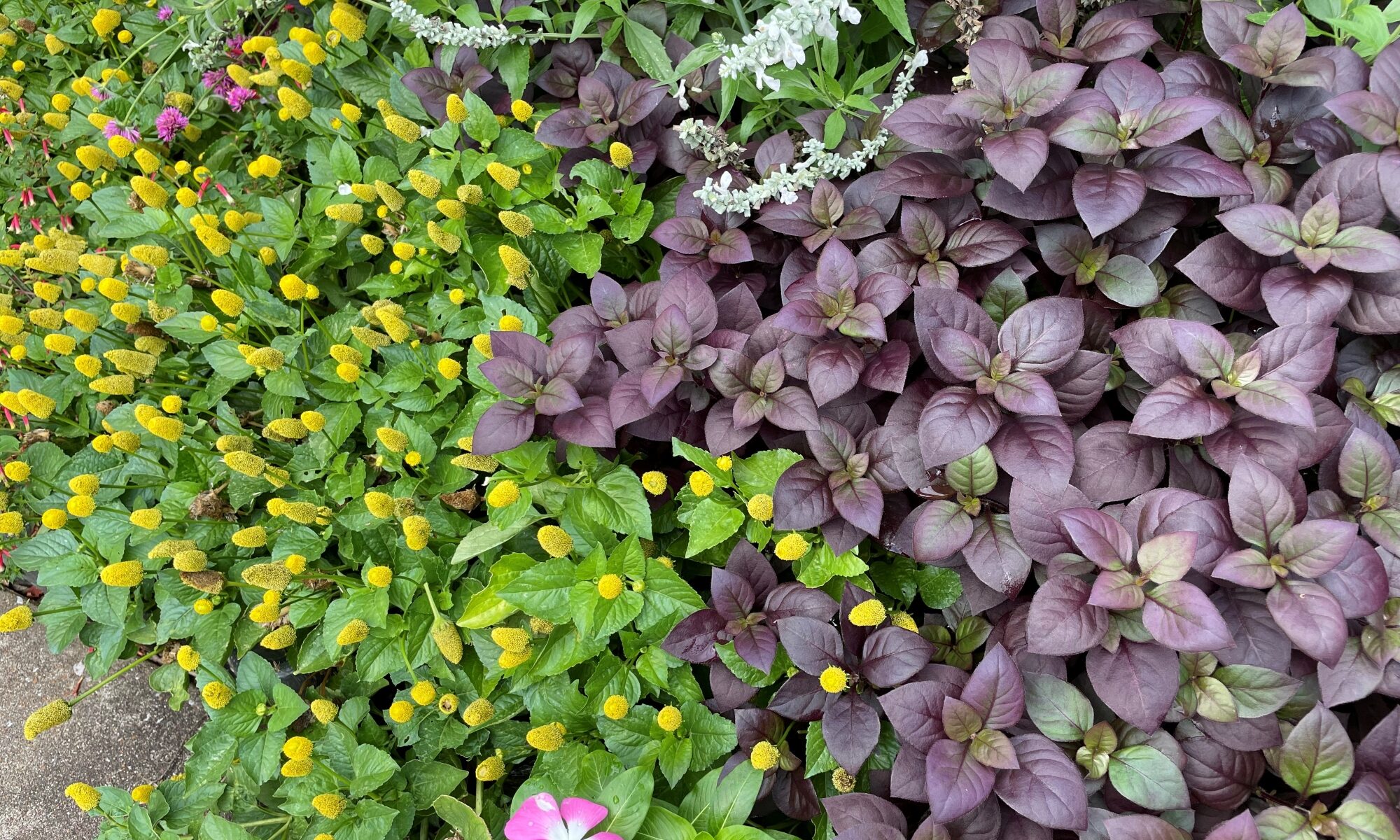
Yellow globes dazzle in full sun and withstand hot and drought conditions
UT Gardens’ June Plant of the Month
Submitted by Karen Caspary, volunteer coordinator and horticulturist, UT Gardens, Knoxville
KNOXVILLE, Tenn. – Acmella oleracea (previously classified as Spilanthes acmella), known by the common names toothache plant, buzz buttons, jambu, or Schezuan button or paracress, is a funny little herb that packs a punch. Its bright color, long bloom time and heat tolerance are not the only reasons why it deserves a spot in the garden: it also carries significant historical and medicinal value.
Most sources agree that spilanthes is native to the jungles of South America, but it’s also been recorded historically in Africa and Southeast Asia. Although its preferred home is a hot, humid environment, it can be grown as a tender annual throughout North America. The common name refers to the plant’s long-standing tradition in dentistry and oral health. Chewing the flowers or leaves produces a strong tingling sensation and gentle numbing that lasts 20-30 minutes, which was employed by dentists and folk healers prior to the availability of modern painkillers.
The plant needs full sun, prefers richer soils and is drought-tolerant once established. With its low-growing habit, it works very well on the front edges of beds or alongside paths. Once it bursts into a small dome of yellow/orange globes in midsummer, overlooking it is nearly impossible. Varieties can be either pure yellow or yellow with deep orange centers—I grow the bright yellow one. It’s easy to save the seeds, which appear on flowerheads after the bright color fades into a light tan. I sprinkle the seed where I want it to grow the following year and save some for greenhouse planting as well.
Last year, I seeded spilanthes in the greenhouse very late–it wasn’t ready for transplant until the end of June. The weather was so hot, I worried I had missed my chance. But the small plants survived the shock effortlessly and began blooming within three weeks. It brought summer color to a hot area of the garden where any other herb would have wilted. I didn’t think I could love it more!
The UT Gardens includes plant collections located in Knoxville, Crossville and Jackson, Tennessee. Designated as the official botanical garden for the State of Tennessee, the UT Gardens are part of the UT Institute of Agriculture. The Gardens’ mission is to foster appreciation, education and stewardship of plants through garden displays, educational programs and research trials. The Gardens are open during all seasons and free to the public. For more information, see the Gardens website: utgardens.tennessee.edu/. The University of Tennessee Institute of Agriculture is comprised of the Herbert College of Agriculture, UT College of Veterinary Medicine, UT AgResearch and UT Extension. Through its land-grant mission of teaching, research and outreach, the Institute touches lives and provides Real. Life. Solutions. to Tennesseans and beyond. utia.tennessee.edu.