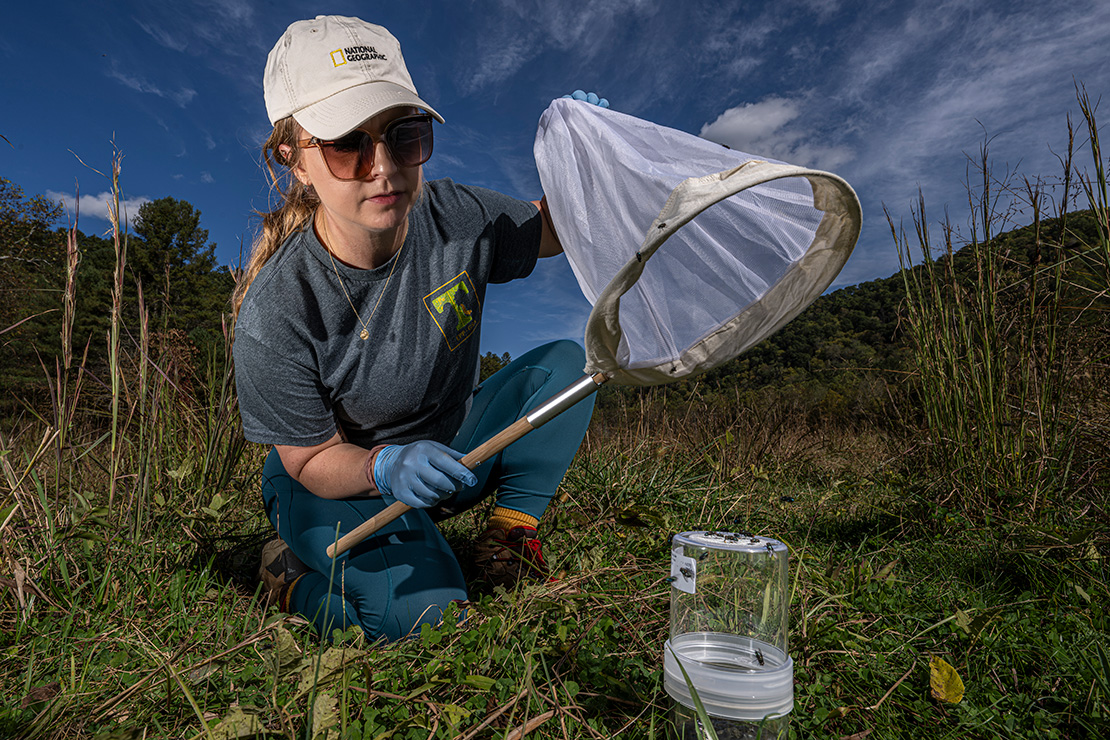
Entomologist tracks how blow flies could be used to detect pathogens in the wild
KNOXVILLE, Tenn. – National Geographic magazine featured the work of University of Tennessee Institute of Agriculture entomologist Charity Owings, who studies how blow flies could be used to detect pathogens harming elk and other animals in the Great Smoky Mountains National Park.
A photographer and writer accompanied Owings, a teaching assistant professor in the Department of Entomology and Plant Pathology, and her graduate student Makhali Voss to the Smokies last fall. The article, “Can Lowly Blowflies Stop the Next Wildlife Pandemic?”, was published in the July 2026 issue of the magazine.
The article details Owings’ method of analyzing the stomach contents of blowflies, who naturally collect traces of DNA from feeding on dead animals and animal waste. By this practice, researchers can determine which pathogens are circulating in the ecosystem without testing wild animals directly. Owings and her team are specifically investigating if the tapeworm parasite Echinococcus granulosus is spreading among the park’s elk. Processing fly samples via portable DNA-testing equipment (a Bento Lab) leads to quicker results than traditional laboratory methods.
Owings received a National Geographic Society grant in 2025 for her research. By invitation of the National Geographic Society, Owings attended the 2026 National Geographic Explorers Festival in Washington, D.C. and the grand opening of the National Geographic Museum of Exploration this past June. While at the festival, she served on an expert panel called, “Science Beyond Research: Conversations on Exploration,” with some of the world’s leading scientists and change-makers. In front of an audience of over three hundred explorers, Owings spoke about the importance of insects, education, and the value of community.
“I grew up reading my granny’s National Geographic magazines and was always captivated by the groundbreaking stories and extraordinary people featured in their pages. To now be recognized by National Geographic and embraced by the Explorer community is one of the greatest honors of my life. I know my granny would be proud,” Owings said.
The Herbert College of Agriculture takes great pride in faculty like Owings, whose work draws the attention of highly respected publications like National Geographic for its contributions to wildlife health.
Owings specializes in forensic entomology, decomposition ecology, population genetics and molecular ecology. After earning her doctorate in biology at Indiana University-Purdue University Indianapolis, she stayed there as a postdoc and studied the use of blow flies as environmental sensors to detect chemical warfare agents. Then, she came to the University of Tennessee and worked in the Forensic Anthropology Center, commonly known as “The Body Farm,” and studied carrion arthropods associated with human decomposition. She has been a member of the UTIA faculty since 2023.
The University of Tennessee Institute of Agriculture is comprised of the Herbert College of Agriculture, UT College of Veterinary Medicine, UT AgResearch and UT Extension. Through its land-grant mission of teaching, research and outreach, the Institute touches lives and provides Real. Life. Solutions. to Tennesseans and beyond. utia.tennessee.edu.