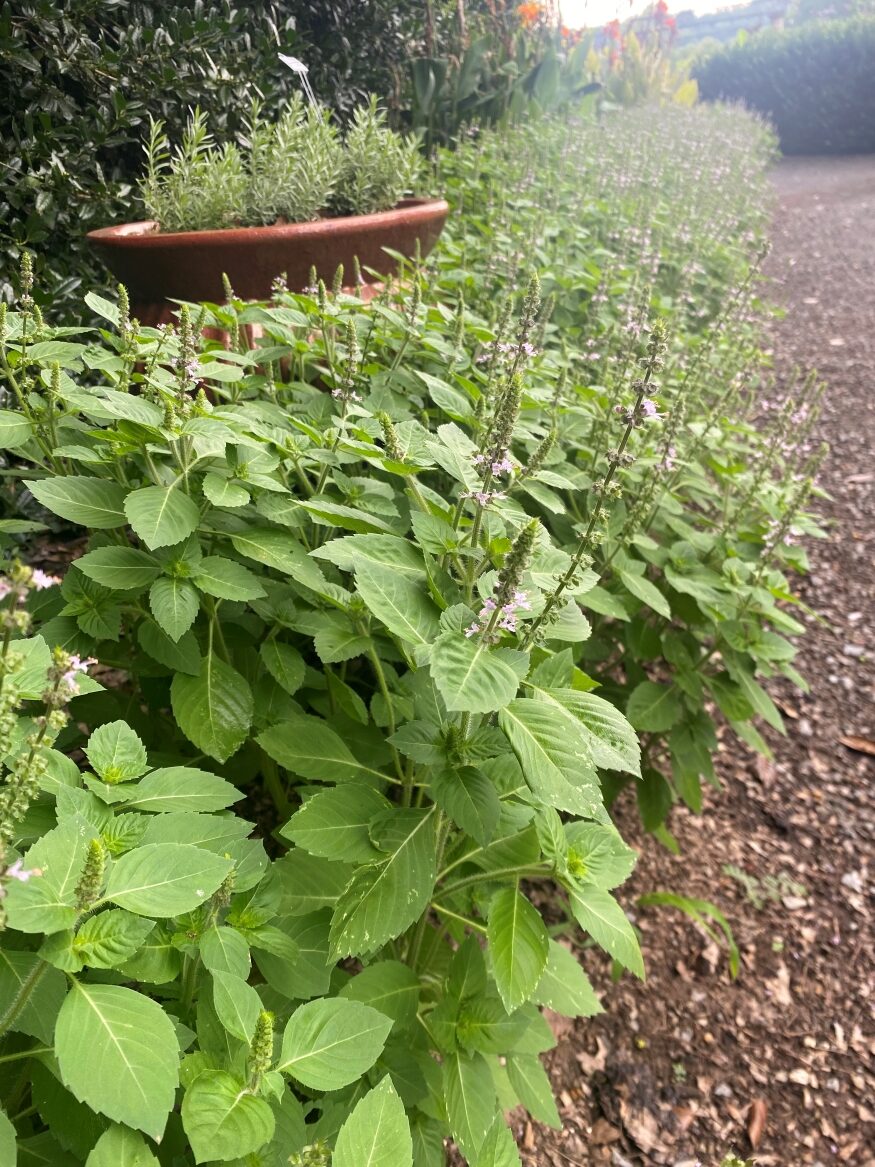
Tulsi, of the mint family, is easy to grow and easy to love
UT Gardens’ September Plant of the Month
Submitted by Karen Caspary, volunteer coordinator, UT Gardens, Knoxville
KNOXVILLE, Tenn. – Tulsi, Ocimum sanctum, also known as the Holy Basil, is a small annual native to the Indian subcontinent. Similar in size and shape to culinary basil, it has duskier, fuzzier leaves and a distinct pleasant aroma. The herb has been used for centuries in medicinal and spiritual practice and has gained great popularity among western herbalists. Easy to grow and easy to love, Tulsi has become a necessity for the modern herb garden or pollinator patch.
There are three distinct varieties of Tulsi: Rama, Vana, and Krishna. Rama is the most common in North American gardens. Like others in the mint family, it has a square stem, opposite leaves and clusters of flowers born close to the central stem. A lover of hot, humid conditions, it grows exceptionally well in the Southern U.S. Plant it in full sun and fertile, well-drained soil—but it’s not picky. I have observed it growing in gravel and along compacted paths. It will self-sow if left to seed in the garden, emerging in late May or early June; we usually start ours in the greenhouse for a more controlled planting. Hot weather doesn’t bother this plant one bit. It thrived when transplanted in sweltering heat that would have knocked another plant out.
Over the season, Tulsi develops into a small bush 18-24 inches tall and wide. The light purple flowers of the Rama variety attract a steady stream of honeybees and solitary bees. In the landscape, it can be massed as a bedding plant, creating a lush short hedge of fluttering dusty-green leaves and purple sprays, or paired with taller flowers. It’s stunning with yellow rudbeckia or large-textured perennials like canna.
Tulsi can be cut several times through the summer months. Much like culinary basil, it forms new bracts at the stem junctures. It is commonly dried for tea, tinctured fresh, consumed as a pot herb, or enjoyed in aromatherapy. In Hindu households, Tulsi is seen as sacred, and it is common to ask permission from the plant before harvesting. In fact, even though India is home to diverse religions and beliefs, Tulsi is considered so holy that every spiritual practice and prayer begins with an offering of Tulsi leaves. Having this plant growing in the Gardens has been a conversation starter on multiple occasions and was the catalyst of some beloved friendships. Tulsi is a plant that brings people together, and for that reason as well as its own nature, it has quickly become one of my favorite herbs.
Tulsi is growing in the UT Gardens, Knoxville, on the path above the rose garden in one of the adopt-a-spot volunteer patches.
The University of Tennessee Institute of Agriculture is comprised of the Herbert College of Agriculture, UT College of Veterinary Medicine, UT AgResearch and UT Extension. Through its land-grant mission of teaching, research and outreach, the Institute touches lives and provides Real. Life. Solutions. to Tennesseans and beyond. utia.tennessee.edu.