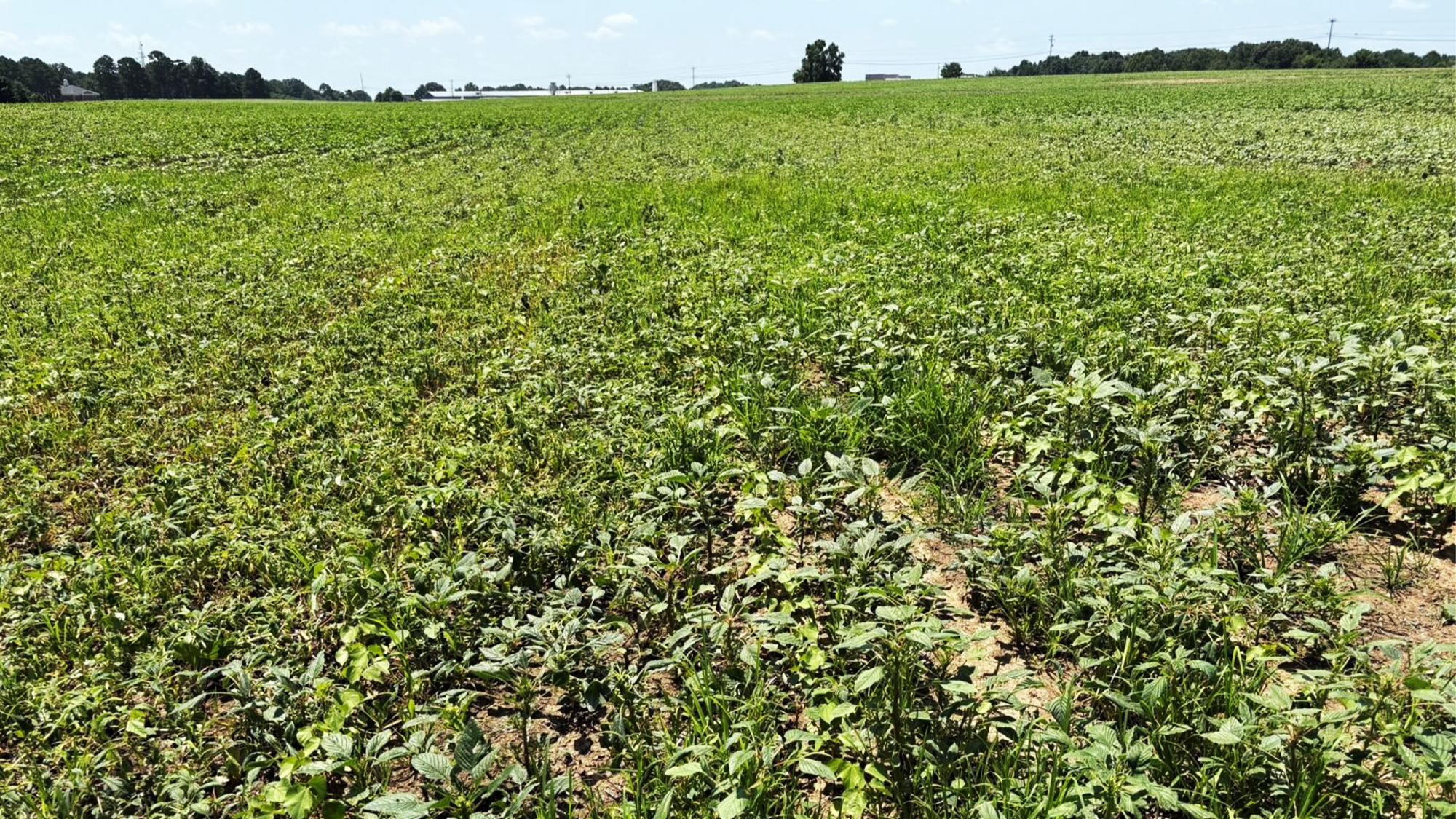
Herbicide-resistant weeds challenge row crop production
MILAN, Tenn. – Effective and affordable weed management is essential for protecting crop yields and maintaining farm profitability. However, increasing herbicide resistance in weed populations is leaving producers with fewer reliable control options. To help growers address these challenges, experts from the University of Tennessee Institute of Agriculture (UTIA) will present their latest research-based recommendations during the 34th Milan No-Till Field Day on July 23, from 8 a.m. to 1 p.m. CDT at the AgResearch and Education Center at Milan. There is no cost to attend.
Attendees can learn more during the tour “Herbicide-Resistant Weed Management” held at 11 a.m. Larry Steckel, row crop weed specialist at UTIA, will partner with Hayden Love, graduate research assistant in the UT Herbert College of Agriculture, to lead this one-hour presentation on emerging resistance issues and practical control strategies.
“Frequent rainfall in June made timely herbicide applications difficult, allowing weed populations to grow beyond ideal treatment stages,” says Steckel. “Palmer amaranth and goosegrass continue to be some of our most troublesome species, and we’re witnessing declining effectiveness of once dependable herbicide options.”
Standard postemergence recommendations for Palmer amaranth have included Liberty, dicamba or a tankmix of the two. However, some populations are showing increased tolerance, allowing plants to survive these applications. This late in the growing season, Steckel recommends hooded or post-direct applications of Liberty tankmixed with either Direx, Caparol, Valor, Zidua or Dual Magnum.
“Our field observations across multiple counties in West Tennessee indicate that Palmer amaranth just two to three inches tall is occasionally escaping Liberty applications as well,” says Sally Reed, graduate research assistant in the UT Herbert College of Agriculture. “In these cases, a rescue treatment featuring a hooded application of Gramoxone tankmixed with either diuron, Caparol or Valor is ideal.”
During the presentation, Steckel will also discuss management strategies for glyphosate-resistant goosegrass, a biotype that continues to spread across Tennessee. Love will share findings from his graduate research on Italian ryegrass, which has become an increasingly significant challenge in Tennessee no-till production.
Milan No-Till Field Day began in 1981 to teach producers about the benefits of no-till farming over traditional tillage. Today, the event is held every other year and continues to attract thousands of people from across the nation interested in improving soil conservation and agricultural production. Instead of tents on the main lawn, all agricultural presentations will begin in the sheds near the lake. Certified Crop Adviser and other pesticide recertification points will be available for attendees.
The AgResearch and Education Center at Milan is located at 3 Ledbetter Gate Road in Milan, Tennessee. For the full event program, including presentations, demonstrations and other activities, please visit milannotill.tennessee.edu.
The University of Tennessee Institute of Agriculture is comprised of the Herbert College of Agriculture, UT College of Veterinary Medicine, UT AgResearch and UT Extension. Through its land-grant mission of teaching, research and outreach, the Institute touches lives and provides Real. Life. Solutions. to Tennesseans and beyond. utia.tennessee.edu.