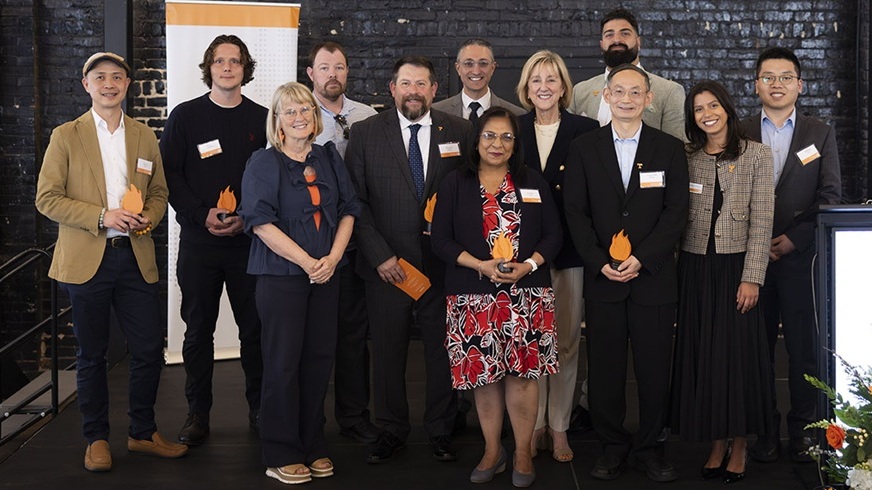
Back row, left to right: Cong Trinh, professor and Ferguson Faculty Fellow; Alex Pfotenhauer, research assistant professor; Scott Lenaghan, associate professor; Maged Guerguis, associate professor and McCarty Holsaple McCarty Endowed Professor; Marc Nabhan, director of entrepreneurship and new ventures; and Weitian Wang, research assistant professor. Middle row, left to right: Deb Crawford, vice chancellor for research; Steven Newby, research assistant professor; Donde Plowman, chancellor; Feng-Yuan Zhang, professor; and Nanda Coimbra, program manager of entrepreneurship and new ventures. Front: Madhu Dhar, research professor.
Regenerative medicine and self-replicating RNA for pesticides in the spotlight
Five teams led by faculty members in the University of Tennessee, Knoxville, each received $50,000 at an April 7 award ceremony for the Chancellor’s Innovation Fund. This year’s awards span the fields of agricultural technology, architectural design and building technology, biomanufacturing, electrochemical energy systems and regenerative medicine.
Two of the teams were led by faculty within the UT Institute of Agriculture. The first team includes Madhu Dhar, research professor, and Steven Newby, research assistant professor, both in the College of Veterinary Medicine. They have designed a novel replacement for standard steel and titanium surgical implants that can be used in animals and humans.
A team including Scott Lenaghan, associate professor of food science in the Herbert College of Agriculture who also serves as co-director of the Center for Agricultural Synthetic Biology (CASB), together with Research Assistant Professor Alex Pfotenhauer, is innovating a next-generation pest control technology to protect Tennessee agriculture and bolster global food security.
Now in its third year, the Chancellor’s Innovation Fund (CIF) strengthens UT’s entrepreneurial impact by bridging publicly funded academic research with private financing or licensure, creating clearer pathways for faculty to commercialize technologies developed through their research. Awardees use the seed funding to refine their technologies, build and test prototypes, validate solutions and assess market opportunities as they advance their work toward real-world application.
Faculty recipients are selected through a competitive process that culminates with a five-minute presentation describing the benefits of their project and how they would use the funding. The UT Research Foundation supports the program by evaluating proposals and providing dedicated coaching sessions. Each technology is evaluated on its ability to address unmet market needs, its proposed development plan, and the potential impact of funding on its commercialization.
“Turning research breakthroughs into real-world technologies is a key way in which we fulfill our responsibility as a land-grant university,” said Deb Crawford, vice chancellor for research, innovation, and economic development. “This initiative closes critical gaps between discovery and impact.”
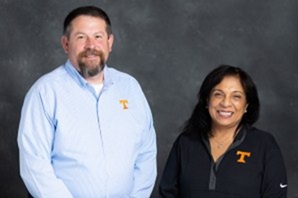
Dhar and Newby’s project is called Bioinks for Tissue Engineering and Regenerative Medicine. Their method uses a novel bioink — a nontoxic biodegradable resin compatible with healthy living cells. It can be tuned to mimic different tissues in the body and can be mixed with nanoparticles that support health outcomes. It will be used to rapidly 3D print implants tailored to patients’ specific needs.
The award funding will help the team demonstrate the ink in action and prove its viability in animal surgical procedures. They will fabricate implants using the Medical Device Innovation Core and the Dhar lab at the UT Center for Precision Health. Ultimately, they envision surgeons printing implants on-site to repair bones, cartilage, skin, and nerves, restoring patients’ quality of life.
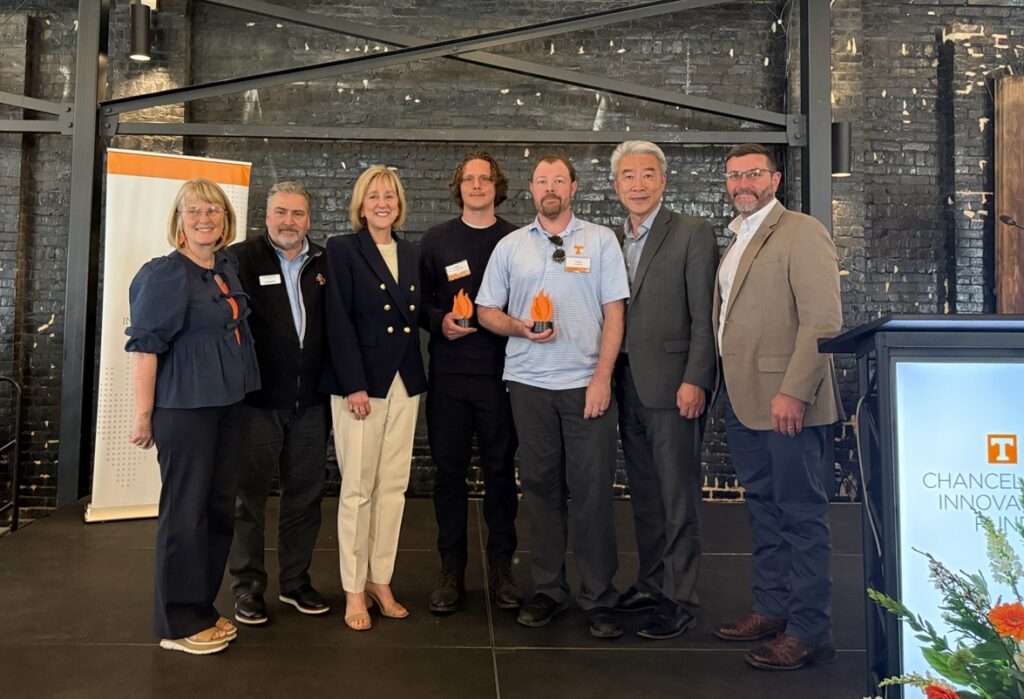
Lenaghan and Pfotenhauer’s project is Self-Replicating RNA for Spray-on Pesticides. The technology is designed to silence specific genes in targeted insect and pathogen species. It kills pests without modifying the plant’s DNA and without using chemical pesticides that could harm beneficial insects or lead to pesticide resistance. Lenaghan and Pfotenhauer’s solution, developed along with CASB Co-Director Neal Stewart, lasts longer and is more cost-effective than similar technologies. Farmers will apply it only once each year to protect their crops. The CIF funds will enable the team to complete greenhouse studies to prove the concept and attract potential buyers.
In addition to the UTIA projects, these projects were selected for CIF awards:
Maged Guerguis: OTTO Prefab and the U-Panel System for Net-Zero Smart Homes
Maged Guerguis, associate professor and McCarty Holsaple McCarty Endowed Professor in the College of Architecture and Design, is using robotic fabrication and advanced manufacturing to transform the construction of energy-efficient high-performance homes.
Cong Trinh: Biomanufacturing Natural Butyl Acetate
Cong Trinh, chemical engineering professor and Ferguson Faculty Fellow in the Tickle College of Engineering, partnered with biotechnology entrepreneur Mounir Izallalen to pioneer a fermentation process for manufacturing butyl acetate. This molecule, which naturally occurs in fruits, serves as a high-value ingredient in applications ranging from food flavorings to pharmaceuticals, cosmetics, and solvents used in microchip production and automotive coatings.
Feng-Yuan Zhang, Matthew Mench, and Weitian Wang: Low-Cost Electrolyzers and Energy Storage
Feng-Yuan Zhang, a professor of mechanical engineering in the Tickle College of Engineering, leads a team that works with government, industry and university collaborators to drive breakthrough innovations in electrode and electrolysis technologies.
More details about the UT Chancellor’s Innovation Awards can be found online here.
The University of Tennessee Institute of Agriculture is comprised of the Herbert College of Agriculture, UT College of Veterinary Medicine, UT AgResearch and UT Extension. Through its land-grant mission of teaching, research and outreach, the Institute touches lives and provides Real. Life. Solutions. to Tennesseans and beyond. utia.tennessee.edu