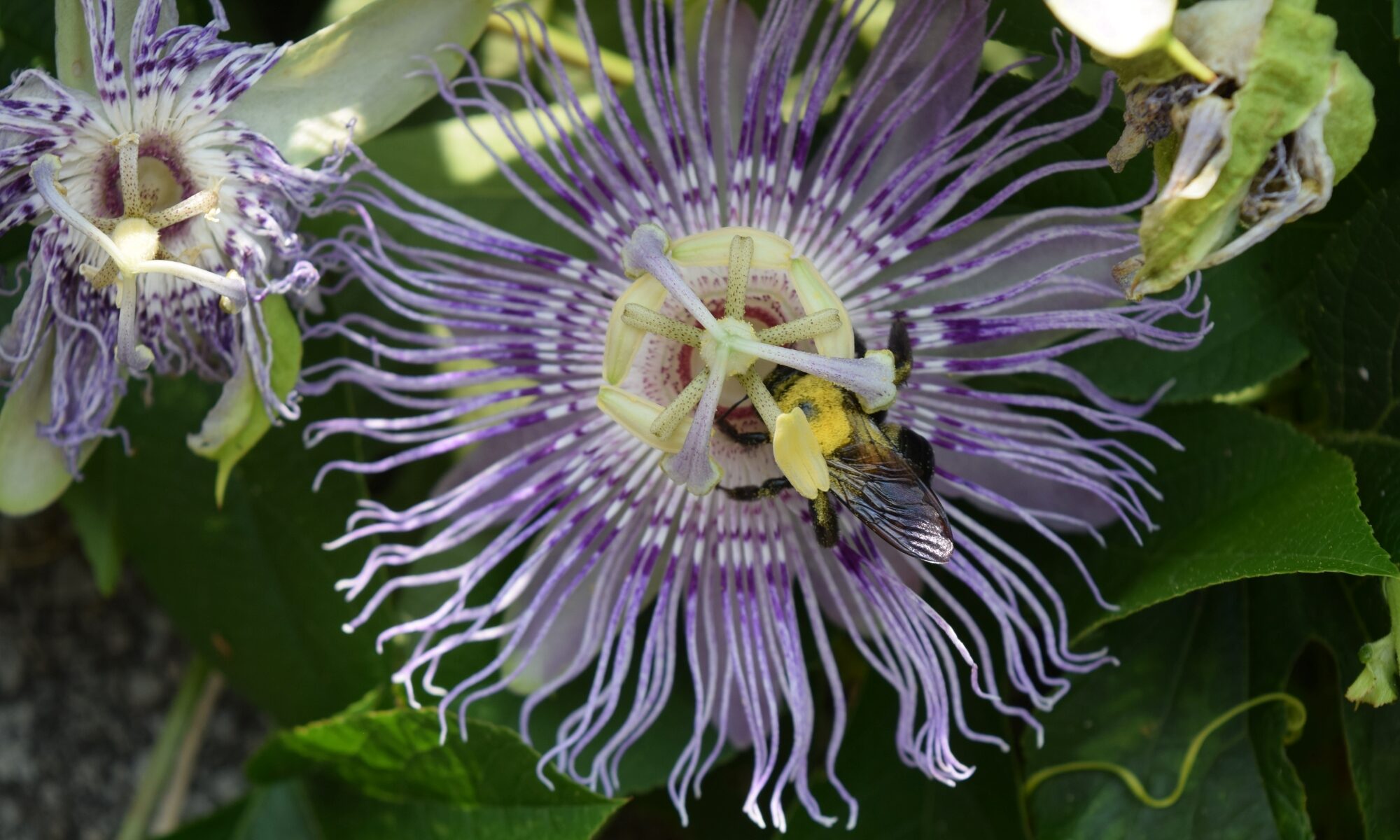
Adaptable vine blooms from June to September and provides edible fruit used for syrups, jelly and tea
UT Gardens’ July Plant of the Month
Submitted by Shalena Durkot, garden coordinator and horticulturist, UT Gardens, Crossville
KNOXVILLE, Tenn. – If the exotic blooms of Passiflora incarnata don’t intrigue you, the plant lore will.
Passion flower is perhaps the most widely used of its common names, which originated with early Christian missionaries who saw various parts of the flowers as symbols of the crucifixion. More rural names of wild apricot and maypop refer to the fruit of the plant. The fruit does make a loud popping noise when crushed, but May is not the season of its ripening this far north.
This adaptable plant grows across Tennessee in sunny spots along waterways, roadways and field edges. No wonder it’s been deemed our state wildflower. In the landscape, it can climb on structures or be left to scramble across the ground. Its vigorous nature requires regularly removing root suckers to control its spread, but for many gardeners, the merits exceed the drawbacks.
Passion flower vines emerge fairly late in the spring, can climb 6 to 8 feet or more, and have alternate three-lobed leaves. The foliage serves as a larval host for several butterflies, most notably gulf and variegated fritillaries.
It will tolerate part shade, but best color and bloom occur in full sun. Gorgeous lavender blooms appear June to September and open and close each day. While they attract a wide range of pollinators, the large bodies of carpenter bees do the best job of carrying pollen from stamen to stigma, ensuring successful pollination.
Pollinated flowers result in green, egg-shaped fruits edible fresh off the vine. In late summer and fall, the fruits will begin to yellow, wrinkle slightly and emit a rich fragrance of tropical punch, which also describes the flavor of the pulp surrounding the hard seeds. Many people eat seeds and all, but simmering in a little hot water will make a juice that can be used for syrups, desserts and jellies, or simply boil the flowers and leaves to make a tea.
Look for passion flower at all three UT Gardens locations. Plants are typically available at native plant nurseries, or propagate your own by cuttings, division and seed.
The UT Gardens includes plant collections located in Knoxville, Crossville and Jackson, Tennessee. Designated as the official botanical garden for the State of Tennessee, the UT Gardens are part of the UT Institute of Agriculture. The Gardens’ mission is to foster appreciation, education and stewardship of plants through garden displays, educational programs and research trials. The Gardens are open during all seasons and free to the public. For more information, visit the Gardens website: utgardens.tennessee.edu/.
The University of Tennessee Institute of Agriculture is comprised of the Herbert College of Agriculture, UT College of Veterinary Medicine, UT AgResearch and UT Extension. Through its land-grant mission of teaching, research and outreach, the Institute touches lives and provides Real. Life. Solutions. to Tennesseans and beyond. utia.tennessee.edu