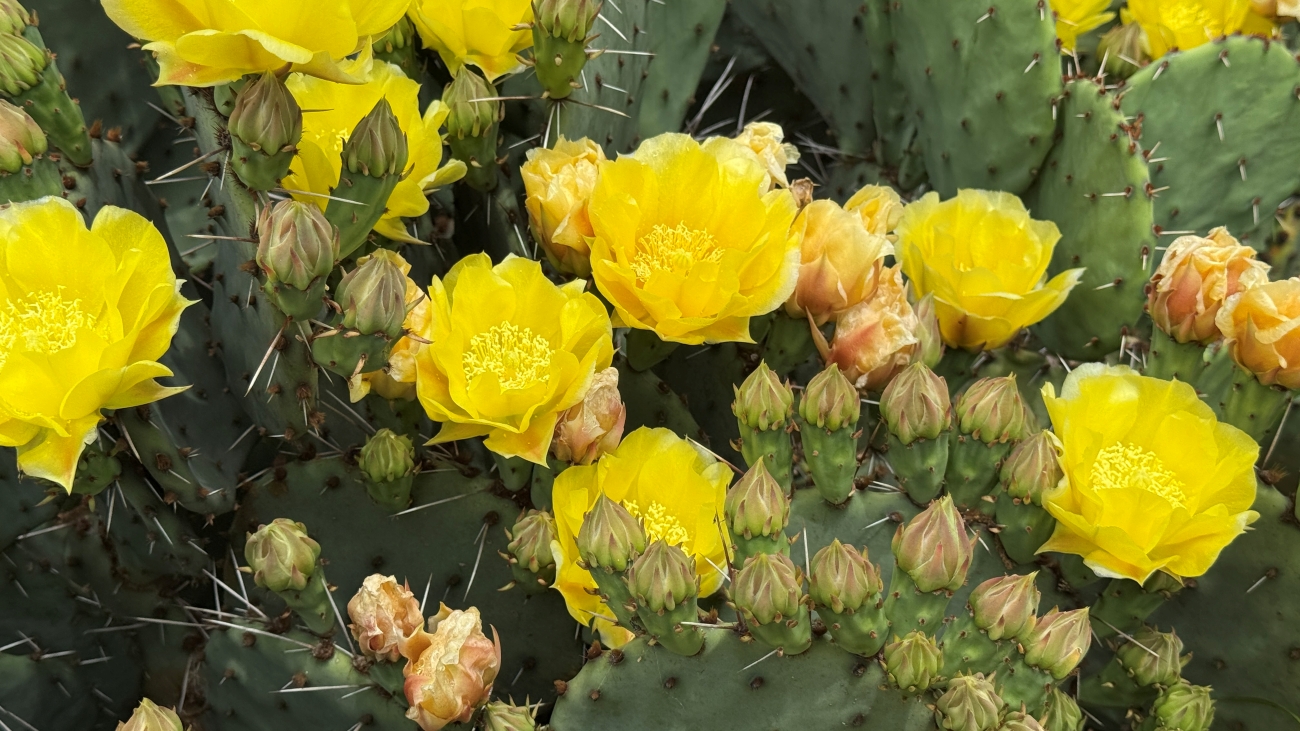
Eastern pickly pear, Opuntia humifusa, is evergreen and boasts vibrant yellow blossoms
UT Gardens’ November Plant of the Month
Submitted by Whitney Hale, Tennessee State University Extension agent, Knox County, and former education coordinator, UT Gardens, Knoxville
KNOXVILLE, Tenn. – If you have traveled from one side of the state of Tennessee to the other, you may have driven past a cedar glade. Cedar glades are unique ecosystems found primarily in Tennessee’s Central Basin that are made up of exposed rocky, limestone environments that are ringed by cedars and have plants like perennial grasses, lichens, moss and the Tennessee cone flower. Another notable plant of the full-sun zones of Tennessee cedar glades is the eastern prickly pear, Opuntia humifusa, which is our only native cactus in Tennessee.
Cedar glades are characterized by cold winters, wet springs and hot, dry summers, and, thus, have many characteristics in common with desert regions, which is why the prickly pear cactus grows so well there. Fortunately for Tennessee gardeners, though, they grow well in many areas across the state.
The pads of the cactus are modified stems that store water, but during periods of drought they may shrivel. During the next rain they will fill out again. Opuntia has few true leaves that only appear on young pads; however, the spines are modified leaves. It also has small, bothersome bristles on the pads and fruits. While both the pad and the fruit (called tunas) of the prickly pear cactus are edible, care should be taken to remove all spines and bristles before consuming.
Opuntia is an excellent addition to a rock garden or to an elevated space that’s very well drained. It is evergreen and has a dense spreading habit. The eastern prickly pear is hardy in Tennessee and grows throughout much of the eastern United States. Its flower is the most striking feature and is a vibrant large yellow blossom with eight to twelve petals and prominent, abundant stamens that attract a variety of pollinators, especially native bees. Blooming May to July, the flowers are often found in a row along the top of the pads. Only two or three will be open on a pad at the same time, and each flower will only bloom for one day. If you’re lucky enough to catch the plant with many of its flowers in bloom, be sure to take a picture. If you come back tomorrow, it won’t look the same.
Visitors to UT Gardens, Knoxville, can find eastern prickly pear in the cactus display in the rock garden, and there is a large specimen at UT Gardens, Jackson, in the parking lot as well.
The University of Tennessee Institute of Agriculture is comprised of the Herbert College of Agriculture, UT College of Veterinary Medicine, UT AgResearch and UT Extension. Through its land-grant mission of teaching, research and outreach, the Institute touches lives and provides Real. Life. Solutions. to Tennesseans and beyond. utia.tennessee.edu.