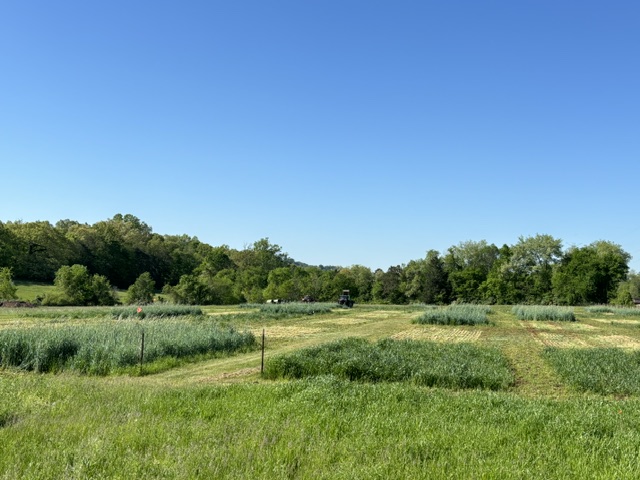
Grass project in Tennessee and Arkansas funded by $2 million grant from USDA
KNOXVILLE, Tenn. – Using native warm-season grasses is critical in helping organic livestock farmers extend the grazing season, but establishment of these grasses such as switchgrass, eastern gamagrass, big bluestem and little bluestem remains a challenge.
With a new $2 million grant from the U.S. Department of Agriculture (USDA), University of Tennessee Institute of Agriculture researchers are studying the best practices for organic establishment of these grasses for farmers who want to incorporate them into their forage systems.
Their project, “Developing a Toolbox for Organic Native Warm-Season Grass Establishment: Planting Windows, Legume Interseeding and Prescribed Burning,” received a grant from the USDA National Institute of Food and Agriculture’s Organic Agriculture Research and Extension Initiative Program. The research team will study forage yield and nutritive value, weed suppression, water and nutrient use, soil health, and economic performance of the grasses over four years.
The research builds on the team’s ongoing project supported by the same funding program, plus input from some stakeholders. There will be two coordinated field trials: one at the UT East Tennessee AgResearch and Education Center and the other at USDA-ARS Dale Bumpers Small Farms Research Center in Booneville, Arkansas. There will also be two on-farm demonstration trials on certified organic lands in Tennessee and Arkansas. The team will study three ways to establish the grasses, including reduced tillage in the spring or fall followed by planting, legume interseeding and prescribed burning. The grass options are switchgrass, eastern gamagrass and a blend of big bluestem, little bluestem, Indiangrass and sideoats grama.
Homeowners with lawns that start to suffer in the late, hot summer can understand the dilemma of having cool-season grasses, particularly tall fescue, in the eastern United States. Cool-season grasses are not suited for hot summer months and also may contain toxic alkaloids that impact livestock health.
“Integrating native warm-season grasses to complement cool season pastures is an attractive practical option to increase summer forage production in this region, but effective and environmentally friendly methods for organic establishment of native warm-season grasses remain limited,” said Sindhu Jagadamma, professor in the Department of Biosystems Engineering and Soil Science and principal investigator for the project.
The goal at the end of the project is to directly inform best management practices for organic forage systems and translate them into targeted Extension activities to enhance producer knowledge, confidence, and adoption of organic livestock farming.
In addition to Jagadamma, the research team includes Patrick Keyser, professor emeritus in the School of Natural Resources; Debasish Saha, associate professor in the Department of Biosystems Engineering and Soil Science; Eric Bisangwa, senior researcher in the School of Natural Resources; Rachel Wooliver, research scientist in the Department of Biosystems Engineering and Soil Science; Andrew Griffith, professor in the Department of Agricultural and Resource Economics; and Jonathan Kubesch, a UT Knoxville graduate and current assistant professor of forages in the University of Arkansas Division of Agriculture. Another collaborator is Christine Nieman, research animal scientist, at the center in Booneville, Arkansas.
The University of Tennessee Institute of Agriculture is comprised of the Herbert College of Agriculture, UT College of Veterinary Medicine, UT AgResearch and UT Extension. Through its land-grant mission of teaching, research and outreach, the Institute touches lives and provides Real. Life. Solutions. to Tennesseans and beyond. utia.tennessee.edu.