UT Gardens’ March Plant of the Month
Submitted by Jennifer Northam, collections manager, UT Gardens, Knoxville
KNOXVILLE, Tenn. – The tomato, Solanum lycopersicum, which translates to comforting wolf peach, has a rather recent recorded history starting in the 1500s. Wild tomatoes were from western South America, cultivated in Central America and brought back to Europe by Cortez, spreading from there. Around the 1940s, tomatoes began to be hybridized for disease resistance, thicker skin and uniform shape for efficient harvesting, transporting and canning, but flavor fell to the wayside.
Heirlooms are open-pollinated, have seeds that grow true to parent and have been passed down for generations at least 50 years. Some say true heirlooms were developed before the 1940s before popular hybrids like ‘Big Boy’ were hybridized.
Commercial heirlooms were developed by seed companies like the Livingston Seed Company founded in 1850 by Alexander Livingston. The ‘Livingston’s Paragon’ tomato was introduced in 1870 and was smooth, uniform, round and meaty. Other significant releases were ‘Golden Queen’ (1882), ‘Stone’ (1889), ‘Gold Ball’ (1892), ‘Dwarf Aristocrat’ (1893), ‘Large Rose Peach’ (1898), ‘Magnus’ (1900), ‘Globe’ (1905) and ‘Oxheart’ (1925).
Family heirloom tomatoes depend on seed saving, sharing and heritage. ‘Cherokee Purple’ came about after a man in Sevierville was given seed by his neighbor whose family was given the purple tomato by Cherokee Indians 100 years ago. The man also gifted seed to tomato aficionado Craig LeHoullier, who helped popularize one of the best tasting tomatoes ever. Other Tennessee heirlooms include ‘Tennessee Britches’, ‘Spear’s TN Green’ and ‘Middle TN Low Acid’. ‘Mortgage Lifter’, ‘San Marzano’, ‘Suddeth’s Strain Brandywine’ and ‘Black Krim’ are also known to do well in East Tennessee.
Tomatoes need full sun, organic matter, some of the stem buried when planting, mulch, soil pH around 6.2-6.8, staking, and pruning of lower leaves. I use an all-purpose organic granular garden fertilizer, blood meal for nitrogen, bone meal for phosphorous when planting and add phosphorous (not nitrogen) again when flowering starts. As long as the plants are watered consistently, calcium from the soil will be transported throughout the plant. Water at base or with drip hose. Harvest when the fruit is 1/3 ripe and bring indoors to finish process. Plant with French marigolds, basil, alyssum, Agastache, chives and cosmos. Heirloom tomato plants are more susceptible to disease, can have lower yields than hybridized tomatoes and should be rotated to different garden beds or grown in fresh straw bales every year to limit pests and disease. They also are more of a challenge to grow in hotter parts of the state.
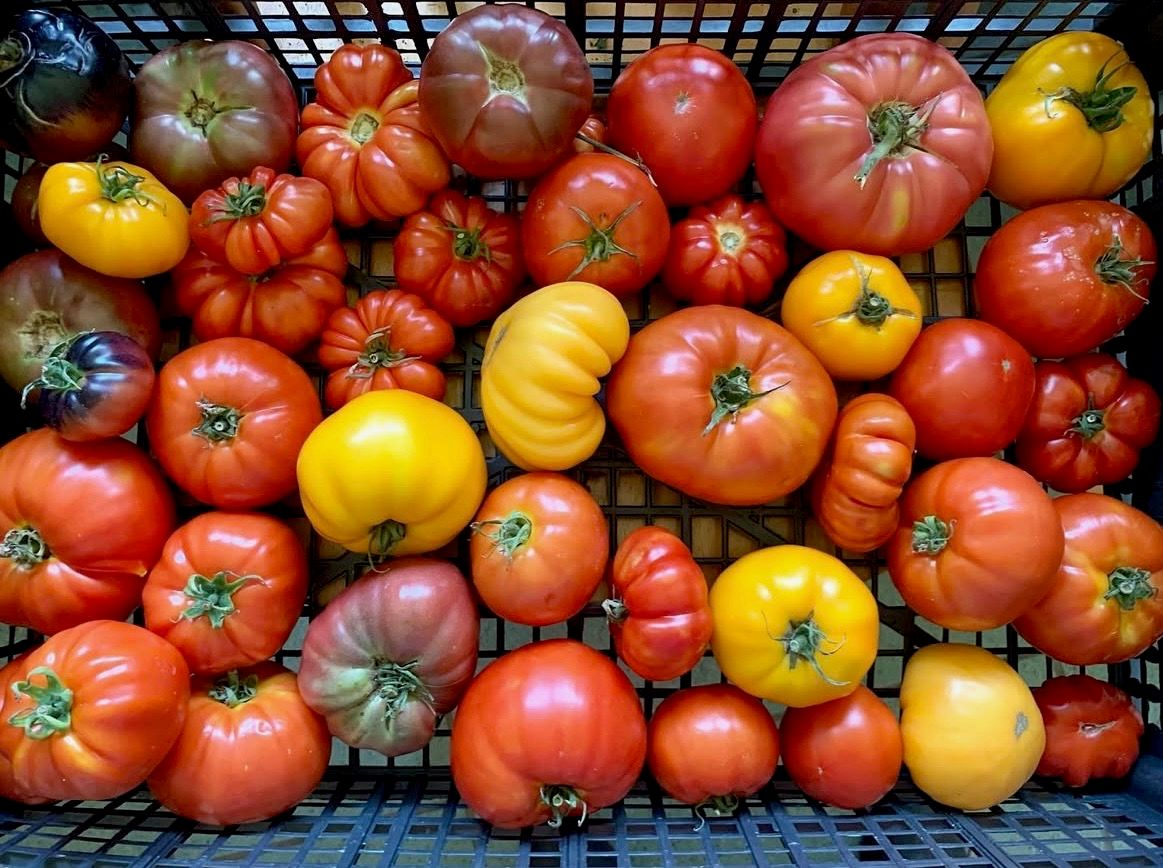
Heirloom tomatoes pack huge personalities filled with history, countless flavors depending on acid and sugar levels, and come in all kinds of shapes and colors. A single type of tomato can taste totally different from one person to another. The coolest part is whatever variety is favored it can be grown again with the preservation of the seeds and their stories.
You will find heirloom tomatoes growing in the kitchen garden in the UT Gardens, Knoxville, and in the UT Gardens, Crossville. Both sites will offer heirloom tomatoes in their spring plant sales.
The UT Gardens includes plant collections located in Knoxville, Crossville and Jackson, Tennessee. Designated as the official botanical garden for the State of Tennessee, the UT Gardens are part of the UT Institute of Agriculture. The Gardens’ mission is to foster appreciation, education and stewardship of plants through garden displays, educational programs and research trials. The Gardens are open during all seasons and free to the public. For more information, see the Gardens website: utgardens.tennessee.edu.
The University of Tennessee Institute of Agriculture is comprised of the Herbert College of Agriculture, UT College of Veterinary Medicine, UT AgResearch and UT Extension. Through its land-grant mission of teaching, research and outreach, the Institute touches lives and provides Real. Life. Solutions. to Tennesseans and beyond. utia.tennessee.edu.