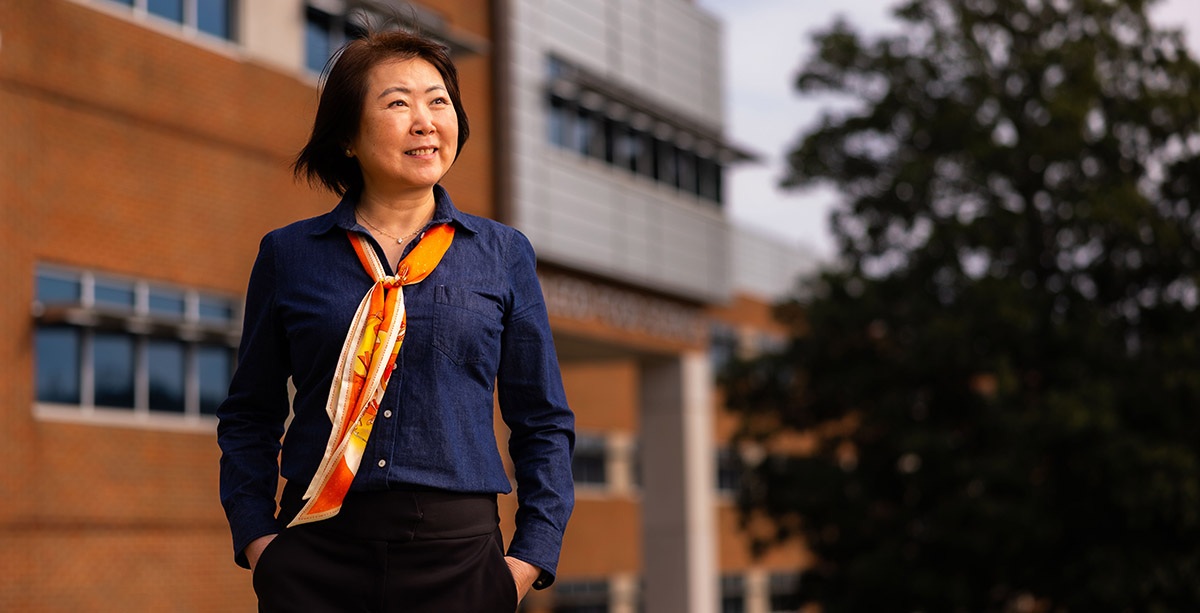
Food Scientist studies the fundamental chemistry of fats, proteins, and other biomaterials
In the University of Tennessee Institute of Agriculture, Toni Wang, the Charles E. Wharton Institute Professor in the Department of Food Science, studies the fundamental chemistry of fats, proteins, and other biomaterials—and how to extract maximum value from them. Her work spans frozen foods, industrial waxes, renewable fuels, and biofertilizers. In her lab, fats, oils, proteins, carbohydrates, and gums are not just ingredients but biomaterials with untapped potential. The unifying theme of her work is value: extracting it, enhancing it, and ensuring that nothing goes to waste.
“Food science is often about much more than food,” Wang says. “It’s about chemistry—understanding structure, functionality, and how molecules interact in a food matrix or as biomaterials. We use that fundamental knowledge to add value to agricultural commodities and biomass, creating higher-value applications from what already exists.”
One of Wang’s projects, funded by the National Science Foundation, focuses on a problem familiar to anyone who has opened a carton of ice cream to reveal a grainy, iced-over texture known as ice crystal growth. As frozen foods sit in storage, small ice crystals merge into larger ones, rupturing cell structure and damaging texture and quality.
“People are constantly trying to find food-safe bio-based ingredients that can slow down ice crystal growth,” Wang explains. “If we can control that growth, we preserve quality.”
Her team studies food-derived protein hydrolysates—small peptides derived from food proteins—as natural agents that can slow ice crystal growth. By combining laboratory experiments with molecular dynamics simulations, they identified specific molecular structures that can disrupt ice crystal formation, helping maintain structural integrity. The combined experimental and computational approach has generated new tools that other scientists are now adopting.
The implications extend beyond ice cream. The findings could improve the freezing stability of high-moisture dairy products and enhance the preservation of biological samples during frozen storage.
In another project, funded by the US Department of Agriculture, Wang is reexamining a material that many industries depend on: carnauba wax.
Imported primarily from Brazil, carnauba wax is valued for its high melting point, durability, and glossy finish, making it a staple in candy coatings, car polishes, and specialty finishes. But its geographically limited availability and price volatility create vulnerabilities for manufacturers.
Wang’s lab is exploring whether domestic seed oils such as soybean and canola oil can be chemically modified to mimic the performance of carnauba wax. By analyzing nanocrystallinity, microaggregation behavior, and structure–function relationships, her team aims to replace decades of trial-and-error formulation with predictive science.
If successful, the research could produce affordable adjustable wax alternatives derived from US agricultural feedstocks—strengthening domestic supply chains while expanding markets for American crops.
Wang is also a Fulbright Scholar and this spring at the University of Iceland she will explore arctic fish and proteins and their hydrolysates for their potent antifreezing and antioxidant activities, which could be used to improve the quality and shelf life of frozen foods and foods containing omega-3 fatty acids. She will also investigate the factors affecting polar lipid recovery from arctic fish and processing byproducts that are rich in high-omega-3 and high-value polar lipids.
For more details about Wang and her work, visit the news web site for the UT Office of Research, Innovation and Economic Development.
The University of Tennessee Institute of Agriculture is comprised of the Herbert College of Agriculture, UT College of Veterinary Medicine, UT AgResearch and UT Extension. Through its land-grant mission of teaching, research and outreach, the Institute touches lives and provides Real. Life. Solutions. to Tennesseans and beyond. utia.tennessee.edu.